
Comparing concrete overlay vs replacement cost in San Jose starts with the condition of your existing slab. Your driveway may be covered in cracks, the patio has faded to a tired gray, or the walkway looks decades older than the house. At some point, every San Jose homeowner with aging concrete asks the same question: can this be fixed with an overlay, or does it all have to be torn out and poured again?
Cost is usually what decides it. But comparing an overlay to a full replacement isn’t as simple as comparing two price tags. The two jobs involve very different amounts of work, and what one costs on your property depends on things no online price chart can see: the condition of your slab, the soil under it, how easy it is to reach, and the finish you want.
This guide walks through what actually drives the cost of each option, the hidden costs that often get left out of the comparison, and how to tell which one your concrete really needs. If you already know you want a new surface without the demolition, our concrete overlay and coating options page covers the systems and finishes we install.

Is an Overlay Cheaper Than Replacement?
In most cases, yes. When the existing slab is structurally sound, an overlay often costs less than tearing out and replacing the concrete, because it skips demolition, hauling, and pouring a new slab. The savings depend on how much preparation and repair the existing slab needs.
The catch is the phrase “structurally sound.” An overlay bonds to the concrete underneath it, so it can only be as good as that base. If the slab is sinking, heaving, or broken through, an overlay won’t fix the problem, and paying for one can end up being the more expensive choice once you factor in replacing it later. That’s why the right answer for your project always starts with an on-site look at the slab.
What's the Difference Between an Overlay and Full Replacement?
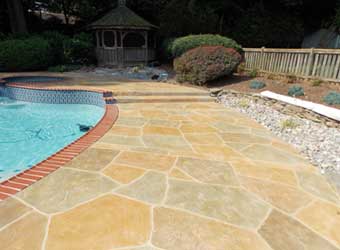
A concrete overlay is a thin cement-based resurfacing layer, often polymer-modified, bonded to existing concrete. Epoxy and polyaspartic floor coatings are separate surface systems; they are not cementitious overlays. After the surface is cleaned, ground, and repaired, the overlay is applied and finished to a new look, whether that’s a smooth self-leveling surface, a stamped stone or brick pattern, a knockdown texture, or a stained or colored finish.
Full replacement means breaking up the old slab, hauling the debris away, re-grading and compacting the base, setting forms and reinforcement, and pouring and finishing brand-new concrete. It’s a construction project, not a surface upgrade, and it’s priced like one.
An overlay is a form of concrete resurfacing and restoration work that retains the existing slab. Full replacement removes that slab and builds a new one.

Concrete Overlay vs Replacement Cost: What You're Paying For
The easiest way to compare the two is to look at the work each one involves. Every line below is something that shows up in an estimate:
Cost factor | Concrete overlay | Full replacement |
Demolition | None; the existing slab stays | Saw-cutting and breaking up the entire slab |
Debris removal | Minimal (grinding dust and patch material) | Hauling and disposal of the old concrete |
Base and sub-grade work | None, unless repairs are needed first | Re-grading, compacting, and sometimes new base material |
Materials | Overlay mix or coating system, primer, sealer | New concrete, reinforcement, forms |
Surface preparation | Grinding or shot-blasting, crack and spall repair | Minimal; the new slab is the surface |
Decorative finish | Stamping, texture, color, or stain added to the overlay | Stamping or color added to the fresh pour, if desired |
Permits | Often not required for a surface overlay (confirm with the City) | Driveway approaches and sidewalks may need City of San Jose review |
Downtime | Typically days | Typically longer, including cure time before driving on it |
Disruption to the property | Low; landscaping and edges stay intact | Higher; equipment access, dust, and possible landscape repair |
The pattern is clear: replacement adds demolition, disposal, and any required base work; the preparation and finishing steps differ between the two options. That’s where most of the price gap comes from.

Concrete Overlay Cost Factors
If your slab is a good candidate for an overlay, these are the things that will move your estimate up or down:
- Condition of the existing slab. The more cracks, spalling, and pitting that need to be repaired before the overlay goes down, the more prep labor goes into the job. A slab in good shape with a worn, faded surface is the least expensive to overlay.
- Surface preparation. Overlays need a clean, profiled surface to bond to. Old sealers, paint, oil stains, or a previous failing coating must be removed or treated as required by the selected system, and some take considerably more grinding than others.
- Type of overlay system. A smooth self-leveling overlay, a spray-down knockdown texture, a stamped overlay, and a garage-floor coating system all use different materials and different amounts of labor. Stamped concrete overlay cost depends partly on pattern complexity and hand detailing, which can add installation time.
- Decorative detail. Multiple colors, hand-stained accents, custom borders, and saw-cut patterns add artistry and time. A single-color finish is the simplest.
- Size and layout of the area. Bigger areas generally cost more in total but can cost less per square foot, because setup and mobilization are spread over more work. Curves, steps, and lots of edges add labor.
- Access. A front driveway a crew can pull up to is easier to work on than a backyard patio reached through a narrow side gate.
- Sealer and topcoat. The protective sealer that finishes the job affects both the upfront cost and how the surface holds up to San Jose’s summer sun and winter rain.
Factors That Affect the Cost of Full Concrete Replacement
Replacement estimates carry their own set of variables, several of which don’t exist on an overlay job:
- Demolition and haul-off. How thick the old slab is, whether it contains rebar or wire mesh, and how far debris has to travel to reach the truck all affect demolition labor and disposal cost.
- Soil and base conditions. Soil conditions vary by property; expansive clay, where present, can swell when wet and shrink when dry. If a slab failed because of the ground underneath it, the base usually needs to be excavated, re-graded, and compacted properly, to address the cause of failure. New concrete can still crack, so site preparation and joint planning matter.
- Drainage fixes. Water pooling against the house or flowing under a slab is a common cause of failure. Correcting the slope or adding drainage can be part of a replacement job.
- Tree roots. Mature street trees and backyard landscaping are a frequent culprit in older San Jose neighborhoods. Root-related movement may require an assessment by a qualified arborist and coordination with the relevant authority before concrete work proceeds.
- Permits and City requirements. Work that touches the public right-of-way, like driveway approaches or sidewalks, may need to go through the City of San Jose. Requirements vary by project, so they should be confirmed during the estimate.
- Finish on the new pour. Plain broom-finished concrete is the most basic option. Stamped or colored concrete adds cost to a replacement just as it does to an overlay.
- Site restoration. Heavy equipment can disturb lawns, irrigation lines, and planting beds along the edges, which sometimes means repairs after the concrete work is done.
The Costs That Don't Show Up on the Estimate
A fair comparison looks beyond the invoice. A few costs are easy to overlook:
- Time without your driveway or patio. Replacement generally keeps an area out of service longer, including curing time before it can take vehicle traffic. An overlay usually gets you back in use sooner.
- Disruption. Demolition is loud and dusty and can mean heavy equipment on your property for several days. An overlay is a much quieter job.
- Long-term maintenance. Decorative overlays and new decorative concrete both need periodic resealing to keep their color and protection. Budget for that either way.
- The cost of choosing wrong. An overlay installed over a failing slab will crack along with it, and you’ll end up paying for replacement anyway. Replacing a slab that only needed a new surface means paying for demolition you didn’t need. Both mistakes cost more than getting the diagnosis right the first time.
When a Concrete Overlay Makes More Financial Sense
An overlay is usually the better value when:
- The slab is structurally sound, without major sinking, heaving, or broken sections
- Damage is mostly cosmetic: fading, staining, surface wear, scaling, or hairline cracks
- You want a new look (stamped, textured, or colored) without paying for demolition
- You’d like to keep downtime and disruption to a minimum
- The existing concrete is in the right place, with slopes and drainage that work
For many San Jose homes, especially driveways and patios that are simply worn out rather than broken, this describes the situation exactly. See our overlay and coating options for the finishes available, or browse ideas for driveway overlays and patio overlays.
Add Your Heading Text Here
Replacement is often the smarter long-term spend when:
- Sections of the slab have sunk, heaved, or shifted, creating trip hazards or poor drainage
- Cracks are wide, run all the way through the slab, or keep getting wider
- The concrete is crumbling or has been patched repeatedly without holding
- The base underneath has failed, or roots or water are actively moving the slab
- You’re changing the size, shape, or layout of the area anyway
If only part of the slab is failing, a combination approach can sometimes work: replacing or repairing the damaged section first, then overlaying the whole area so everything matches. Our concrete repair team can tell you whether that’s an option for your project.
Why an Online Price Won't Tell You What Your Project Costs
You’ll find plenty of per-square-foot numbers online, but they’re national averages built from other people’s slabs. They can’t account for the clay soil under your driveway, the tree roots near your patio, the old sealer that needs to come off, or the stamped pattern you have in mind. Those are exactly the things that decide both the price and whether an overlay will even hold.
That’s why the most reliable way to compare an overlay with replacement is to have both options priced for your actual concrete. At San Jose Concrete Resurfacing, a on-site evaluation can help clarify:
- An inspection of the slab’s condition, cracks, and any signs of movement or drainage problems
- Whether the existing concrete can support an overlay or needs further structural assessment or replacement
- A written estimate explaining the proposed preparation, repairs, finish, and project scope
- Finish and color options that fit your home and your budget
We specialize in resurfacing, so when an overlay will do the job, we’ll tell you. And when it won’t, we’ll tell you that too, rather than selling you a surface that won’t last.
Get an Accurate Overlay vs. Replacement Estimate in San Jose
If you’re weighing an overlay against tearing out your driveway, patio, walkway, or garage floor, the fastest way to a real answer is a free, no-obligation evaluation. San Jose Concrete Resurfacing serves San Jose and nearby communities including Santa Clara, Sunnyvale, Cupertino, Campbell, Los Gatos, and Milpitas.
Learn more about our concrete overlay and coating services, request your free quote, or call (408) 709-7256 to schedule your on-site consultation.
Frequently Asked Questions
Usually, yes. When the existing slab is structurally sound, an overlay often costs less than full replacement because it skips demolition, debris hauling, and pouring new concrete. If the slab is sinking, heaving, or broken through, replacement may be the better long-term value. An on-site evaluation is the only way to know which applies to your concrete.
The main factors are the condition of the existing slab and how much repair it needs, the surface preparation required (such as removing old sealers or coatings), the type of overlay system, the decorative finish, the size and layout of the area, access for the crew, and the sealer used to finish the job.
Replacement includes everything needed to build a new slab: demolition, hauling and disposal of the old concrete, base re-grading and compaction, forms and reinforcement, new concrete, and any drainage or root corrections. It can also involve permits and restoring landscaping disturbed by equipment.
Often, yes, as long as the cracks are cosmetic or minor and the slab isn’t moving. Cracks are assessed and repaired during surface preparation before the overlay goes down, but even repaired cracks can reappear through the new surface. Wide, active, or structural cracks usually point to a problem that an overlay can’t fix.
A driveway that is worn, faded, stained, or lightly cracked but still level is usually a good candidate for an overlay. Sunken or heaving sections, crumbling concrete, or cracks that keep widening usually mean replacement. A professional inspection can confirm which one your driveway needs.
Pricing depends on your specific slab, site, and finish, so an accurate number requires an on-site look. San Jose Concrete Resurfacing offers a free, no-obligation evaluation and itemized estimate. Call (408) 709-7256 or request a quote online.